
Зміст
Using frankincense essential oil instead of tincture may seem like a simple swap when both products come in dropper bottles. It is not. The liquids are prepared differently, contain different fractions of Boswellia resin, and may have different intended uses. This guide explains why a tincture’s directions for use in water cannot be transferred to an essential oil. HerbEra describes its frankincense liquid as alcohol-free and gives directions for adding that extract to water or juice; those directions apply to that product, not to other frankincense bottles.
Short answer: Do not replace measured tincture drops with essential oil drops in a drink. There is no reliable drop-for-drop conversion, and adding an essential oil to water does not establish that it is suitable to swallow.
Can frankincense essential oil replace tincture drops in drinking water?
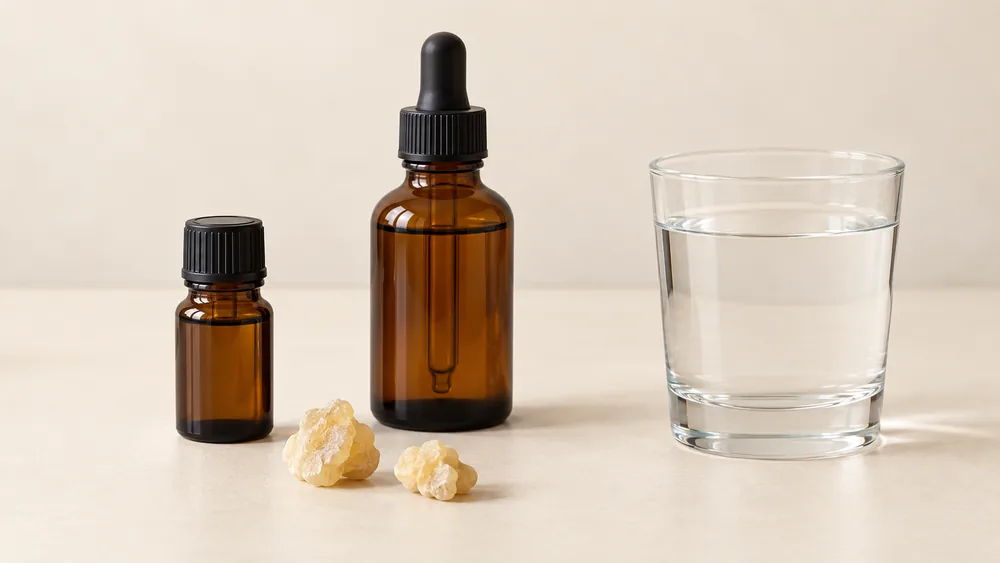
No. A direction printed on a liquid extract applies to its finished formulation. It does not authorize the same use for a separate essential oil, even if both products name frankincense on the front label.
The word “drop” describes how liquid leaves a bottle. It does not describe the liquid’s composition, concentration, or intended route of use. Drop size can also vary with the bottle opening and the liquid itself. Equal numbers of drops would not mean equal amounts of Boswellia compounds.
Essential oils are concentrated aromatic products. Some are ingredients in professionally formulated foods, but that fact does not make a retail bottle of pure essential oil interchangeable with a liquid supplement. Check the exact product’s directions instead of relying on claims such as “pure,” “natural,” or “therapeutic grade.”
How are frankincense essential oil and tincture different?
Essential oil usually comes from distilling Boswellia resin to collect volatile aromatic compounds. A tincture or other liquid extract uses a solvent to draw substances from the resin. The solvent and manufacturing method determine what enters the finished liquid.
Distilled essential oil
Steam or water distillation separates an aromatic oil from other parts of the resin. The oil contains volatile compounds, including terpenes. It is not simply a concentrated version of every substance in the original resin. Product composition can also vary by Boswellia species and distillation method.
Liquid resin extract
A frankincense liquid extract starts with resin and a stated or unstated extraction process. Its finished ingredients may include water, alcohol, glycerin, or other components, depending on the product. The name “tincture” alone does not disclose the solvent, the amount of resin extracted, or the amount of any compound per serving.
Boswellic acids are nonvolatile resin constituents. They are not appropriate markers for a conventional steam-distilled essential oil. An extract may have a different chemical profile, but its label or batch analysis must establish what is present in the finished product. Do not assume that every tincture contains a measured amount of boswellic acids.
What does a side-by-side label comparison show?
The most useful distinction is intended use. The table describes product categories, not a promise about every bottle sold under either name.
|
Detail |
Frankincense essential oil |
Frankincense liquid extract |
|---|---|---|
|
Typical preparation |
Distillation of aromatic material from Boswellia resin |
Extraction of resin using a liquid solvent |
|
Main chemical focus |
Volatile aromatic compounds |
Depends on the resin, solvent, and process |
|
Boswellic acid information |
Not a suitable primary marker for steam-distilled oil |
Requires product-specific testing to confirm and quantify |
|
Intended use |
Must be checked on the exact oil label |
Must be checked on the exact extract label |
|
Use in drinking water |
Adding water does not establish suitability for swallowing |
Follow only the directions for the finished product |
|
Drop comparison |
No reliable drop-for-drop substitution is available |
|
Two products may even come from different Boswellia species while sharing the common name frankincense. Look for the botanical name on each label. A shared plant name does not erase differences in preparation or intended use.
Does mixing essential oil into water make it suitable to drink?
No. Essential oils do not readily mix with plain water. Visible droplets may remain or gather at the surface rather than dispersing evenly. Stirring a glass cannot establish how much oil a person would encounter in any particular sip.
More importantly, water does not change the oil’s product category or replace an appropriate safety assessment. A bottle intended for fragrance, a diffuser, or skin application does not become a drinkable supplement when its contents are added to water. Poison Control warns that misuse of essential oils can cause serious harm and advises following the directions for the specific product.
Do not interpret “food grade” as a drop-for-drop drinking instruction. An essential oil used as an ingredient in a finished food may be handled and formulated differently from an undiluted consumer oil. The relevant question is what the exact bottle says it is for, not whether the plant has ever been used in food.
Which label details matter most?
Start with the intended route: is the finished product labeled for oral use, external use, or fragrance? If you are comparing an aroma oil with a frankincense liquid labeled for mixing with water, do not transfer directions from one label to the other.
Product identity and full ingredients
Check whether the bottle says essential oil, liquid extract, tincture, or another preparation. Read the complete ingredients, including any carrier oils, solvents, flavors, or added substances. A dropper cap does not identify what is inside.
Botanical species and plant material
Look for the Boswellia species and confirmation that resin is the starting material. “Frankincense” can refer to resin from more than one species. The scientific name helps identify the ingredient but does not, by itself, establish the contents of the finished bottle.
Directions and warnings
Read the instructions printed for that product and market. If the label says external use only, do not reinterpret it as directions for a drink. If the intended use is unclear, ask the manufacturer rather than guessing.
Batch-specific evidence
When a seller highlights chemical content or testing, ask what was measured and whether the result matches the lot on the bottle. An essential oil’s volatile-compound profile and an extract’s resin-compound profile require different analytical questions. A generic “tested” claim does not answer either one in detail.
HerbEra’s editorial position is straightforward: directions for a finished liquid extract should never be presented as permission to swallow a different product. The label and formulation must be assessed separately for every bottle.
What if someone has already swallowed essential oil?
Seek product-specific advice promptly from a local poison center or healthcare service, even if the amount seems small. Have the bottle available so the adviser can identify the oil and any other ingredients. If the person has trouble breathing, seek emergency help immediately.
This is not a reason to assume every essential oil exposure has the same outcome. The oil, amount, formulation, age of the person, and circumstances all matter. It is also why an online tincture serving cannot serve as a safety guide for an essential oil.
Checklist: check the bottle before using frankincense drops
Use this checklist for the product you actually hold, not for another item with a similar name. It is designed to avoid a mistaken substitution, not to calculate an essential-oil serving.
Read the product type
Identify whether the bottle contains an essential oil or a liquid resin extract. Do not rely on its cap, color, or scent.
Find the intended use
Check the exact label for its route of use. Do not apply another product’s directions to this one.
Review all ingredients
Look beyond the plant name for solvents, carriers, and other added ingredients. These details describe the finished formulation.
Check the species
Find the botanical name if it is provided. Different Boswellia species can have different chemical profiles.
Ignore drop-for-drop claims
Do not convert an extract serving into an essential-oil drop count. The two liquids are not compositionally equivalent.
Ask when information is missing
Contact the manufacturer about unclear labeling or batch data. If the question concerns someone who has swallowed an oil, contact a poison center instead of waiting for a seller’s reply.
FAQ
Can I use frankincense essential oil in place of tincture drops?
No. They are different preparations, and a tincture’s directions do not apply to an essential oil.
Does adding essential oil to water make it safe to swallow?
No. Plain water does not reliably disperse essential oil or establish that the product is suitable for oral use.
Is one drop of essential oil equal to one drop of tincture?
No. Drop size and chemical composition vary. There is no dependable drop-for-drop conversion.
Do frankincense essential oils contain boswellic acids?
Conventional steam-distilled essential oils are not expected to carry these nonvolatile resin compounds. Check product-specific analysis for any composition claim.
Does “pure” mean an essential oil is suitable for drinking?
No. Purity does not state the intended route of use or establish suitability for swallowing.
Can a frankincense liquid extract contain alcohol?
Yes. Liquid extracts vary. Read the finished ingredients and any alcohol statement on the exact bottle.
What should I do after accidental essential-oil ingestion?
Contact a local poison center or healthcare service promptly with the product bottle at hand. Seek emergency help for breathing difficulty.
Glossary
Boswellia
A genus of trees that produce resins sold as frankincense.
Resin
The aromatic material collected from a Boswellia tree.
Essential oil
A concentrated mixture of volatile aromatic compounds separated from plant material.
Liquid extract
A preparation made by drawing substances from raw material into a solvent.
Tincture
A name commonly used for a liquid botanical extract; its actual ingredients must be checked.
Volatile compound
A substance that can enter the vapor phase during processes such as distillation.
Boswellic acids
Nonvolatile compounds associated with the resin of certain Boswellia species.
Intended route
How the finished product is labeled to be used, such as by mouth or on the skin.
Conclusion
Frankincense essential oil is not a substitute for tincture drops in drinking water. Check the intended use and complete formulation of each bottle separately, and never infer an essential-oil serving from a liquid extract’s directions.
Sources Used
-
Essential oil ingestion risks and poison-center guidance – poison.org/articles/essential-oils
-
Frankincense liquid extract description and directions – herb-era.com/products/frankincense-tincture
-
Study of steam-distilled Boswellia sacra oil and separated resin fractions – pmc.ncbi.nlm.nih.gov/articles/PMC10527873
-
Research on volatile compounds in frankincense essential oils – pmc.ncbi.nlm.nih.gov/articles/PMC9415502
-
Explanation of why essential oils do not mix with plain water – tisserandinstitute.org/learn-more/bath-safety-2
-
Review of Boswellia resin compounds and species differences – pmc.ncbi.nlm.nih.gov/articles/PMC3847453